
In 2026, organisations across Australia and New Zealand face an unprecedented combination of economic headwinds, evolving customer expectations and global volatility—from supply chain uncertainties and cost-of-living pressures to the rapid adoption of digital behaviors. In this climate, customer experience (CX) is no longer a “nice-to-have”—it’s a strategic differentiator that directly impacts loyalty, retention, and organisational resilience.
At the heart of modern CX is micro feedback: the continuous collection of small, context-rich insights directly from customers at key touchpoints. Unlike traditional surveys, micro feedback captures sentiment at the moment it matters, enabling faster decision-making and a deeper connection with customers.
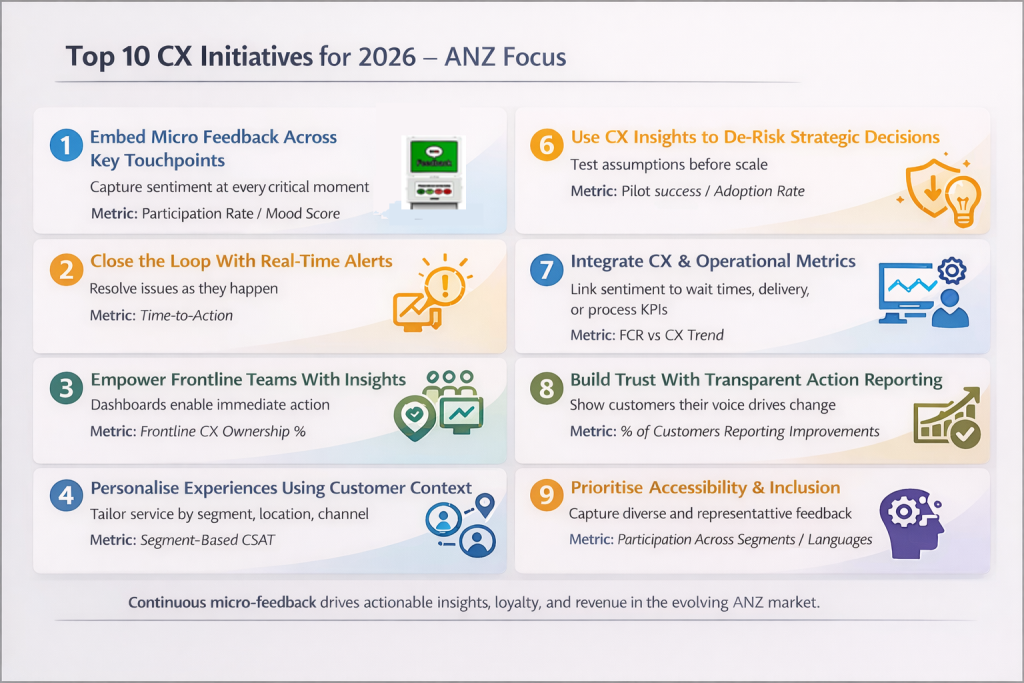
Here are the top 10 CX initiatives organisations should focus on in 2026, with a strong emphasis on using micro feedback to drive meaningful change.
1. Embed Micro Feedback Across All Key Touchpoints
In 2026, customers expect their voice to be heard in real time. Embedding simple feedback prompts at key moments—after transactions, in queues, on mobile apps or at kiosks—captures sentiment when it’s most genuine and actionable.
Why it matters:
• Rapid insights accelerate improvements
• Reduces reliance on sporadic, lengthy surveys
• Strengthens responsiveness in a tight economic environment
2. Close the Loop With Real-Time Alerts and Follow-Up Workflows
Collecting feedback is only the start. Organisations must develop systems that generate real-time alerts when customers signal dissatisfaction and trigger follow-up actions within hours, not weeks.
Why it matters:
• Immediate resolution increases trust and loyalty
• Limits churn in a competitive market
3. Empower Frontline Teams With Instant Insights
Frontline staff are closest to your customers and often the most under-utilised source of improvement ideas. Give them access to live micro feedback dashboards and empower them to act on patterns they see.
Why it matters:
• Increases frontline ownership
• Improves service delivery where it counts
4. Personalise the Experience with Customer Context
Collecting micro feedback tied to customer segments (e.g., local/regional differences in ANZ) helps organisations tailor experiences and promotions that resonate with diverse audiences.
Why it matters:
• Personalisation drives higher satisfaction and conversion
• Supports differentiated approaches across AU/NZ markets
5. Connect Micro Feedback to Employee Experience (EX)
Many organisations overlook the correlation between employee satisfaction and customer satisfaction. Feedback from customers can help diagnose bottlenecks impacting employees, enabling better support and training initiatives.
Why it matters:
• Boosts morale and reduces turnover
• Improves service delivery capability
6. Use Micro Feedback to De-Risk Strategic Decisions
Strategic investments—new channels, pricing changes, digital redesigns—shouldn’t rely solely on quarterly surveys or historical data. Use continuous micro feedback to validate assumptions before rolling out change at scale.
Why it matters:
• Reduces risk in turbulent economic conditions
• Enables iterative, data-driven innovation
7. Integrate CX Measurements With Operational Metrics
Historically, operational metrics (e.g., wait times, service cycles) have lived in silos from CX measurements. In 2026, link micro feedback with these operational KPIs to spot where process improvements deliver the greatest customer impact.
Why it matters:
• Highlights ROI of operational improvements
• Encourages cross-functional collaboration
8. Build Trust With Transparent Action Reporting
Customers need to see that their feedback leads to positive change. Regularly communicate improvements based on what customers have shared—whether through signage, digital channels, or service reps.
Why it matters:
• Reinforces brand transparency in an era of sceptical consumers
• Strengthens customer loyalty
9. Prioritise Accessibility and Inclusion in Feedback Channels
An increasingly diverse ANZ population demands inclusive feedback mechanisms—simple, multilingual, and accessible to all age groups and abilities.
Why it matters:
• Broadens representation in customer insights
• Avoids blind spots that can damage brand reputation
10. Leverage Predictive Insights Through AI and Learning Models
As data volumes grow, organisations must shift from descriptive to predictive insights—using machine learning to identify patterns in micro feedback that signal emerging customer sentiment trends.
Why it matters:
• Forecasts demand changes and customer disengagement
• Converts feedback into predictive action
Conclusion: Micro Feedback Is the CX Currency of 2026
In the economic and social landscape of 2026—marked by resurgent inflation pressures, tighter consumer spending, digital acceleration and talent shortages—businesses can no longer afford blind spots in customer experience.
Micro feedback isn’t about asking more questions—it’s about asking the right questions at the right time, empowering teams to act fast, and building systems that turn insights into measurable value.
Organisations in Australia and New Zealand that prioritise these CX initiatives will be better positioned to build resilience, deepen customer trust, and drive sustainable growth in an increasingly dynamic world.